
Building Something
Introducing the Daily Holiness Workbook — and why I almost called it something else

I want to tell you about a word I almost used.
The word was recovery.
It’s a good word. An honorable word. It has helped millions of people
name what they were doing and find others doing the same thing.
And yet.
Every time I sat down to write this workbook,
the word felt like it was pointing in the wrong direction.
Recovery says: go back. Retrieve what was lost. Return to who you were.
But the people I sit with every week — the individuals,
the spouses, the parents, the adult children —
they are not trying to go back.
Going back, for most of them, is not actually an option.
And more to the point: going back is not the goal.
The goal is forward. Higher.
The goal is becoming someone they haven’t fully been yet.
That’s discovery.
The workbook.
I am genuinely pleased to share something I’ve been building for a while:
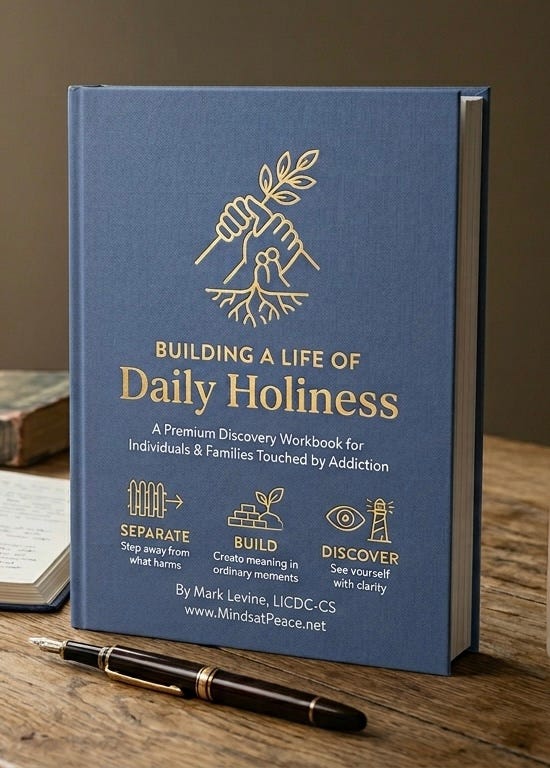
*Building a Life of Daily Holiness: A Premium Discovery Workbook
for Individuals and Families Touched by Addiction.*
The short version: it’s a structured, honest, warmly challenging
workbook for people navigating addiction — their own, or someone
they love — that asks two foundational questions:
What do I need to step away from?
And: what am I building in its place?
Why holiness?
I know. Of all the words.
Here’s why.
The Hebrew concept of kadosh — holiness — means to be set apart.
Consecrated. Dedicated to something that matters.
It doesn’t mean perfect. It doesn’t mean untouched by struggle.
It means oriented. Intentional. Pointed in a direction that matters.
Which is exactly what I watch people do when they begin to find
their way out of addiction.
They don’t become perfect.
They become more deliberately themselves.
They start making choices — small, ordinary, unglamorous choices —
that say: this is who I am becoming.
That’s holiness. That’s what it has always meant.
And when I looked at what actually works in recovery —
in discovery — it looked exactly like that.
Not the dramatic gesture. The daily practice.
Not the single transformative moment.
The meal eaten with presence. The conversation had honestly.
The boundary created in advance, when thinking clearly,
so you don’t have to create it in the moment, when you’re not.
What’s inside.
The workbook has two parts — one for individuals, one for families —
because addiction is a family experience.
Every person in the household feels it.
In different ways, with different costs.
And families need their own tools,
not just tools for supporting the person in the center of the struggle.
For individuals:
The workbook moves through two movements — Separation and Building —
and then introduces what I call the Discovery Lens:
three questions to return to regularly.
Clarity. What am I actually seeing, beneath the story I’ve been telling?
Capacity. What discomfort am I willing to sit with, rather than escape?
Connection. Who supports me in becoming better?
For families:
The same movements, applied to the family system:
the patterns that have developed around the addiction,
the roles that have hardened,
the conversations that keep circling the same drain,
and the small, intentional acts that begin to change the atmosphere of a home.
A word about what this isn’t.
This workbook is not a replacement for therapy, treatment, or medical care.
It is not a 12-step program, though it works well alongside one.
It is not a religious text, though it draws on Jewish concepts
that have been doing this work for a few thousand years
and seem to still be relevant.
It is a companion.
Something to sit with for twenty quiet minutes.
Something to bring to a family conversation that needs a new entry point.
Something that says: you are not the first person to stand in this spot.
And there is a path forward from here.
One more thing.
At the end of the workbook, there is a closing word that includes this sentence:
“Every page you completed here, every honest sentence you wrote,
every question you stayed with instead of closing —
that was an act of holiness.”
I mean that.
Not as motivation. As description.
The willingness to look honestly at your own life —
to sit with the uncomfortable question instead of closing the workbook —
is exactly what the tradition calls setting yourself apart.
Dedicated to something that matters.
That’s you, doing this.
---
Building a Life of Daily Holiness is available at mindsatpeace.net or right here.
If something in this post resonated — for yourself or for someone you love —
feel free to share it. And if you want to explore this work with support,
I’m available for individual and family sessions.
Mark Levine, LICDC-CS
mark@mindsatpeace.net
If you’re a clinician interested in using it with clients, reach out directly —
I’m happy to talk about how it fits into clinical practice.